menu

Warehouse Flood Restoration in Miami | Industrial-Grade Response That Keeps Your Operations Running

When floodwater compromises your Miami warehouse, you need commercial flood remediation experts who understand inventory protection, safety codes, and rapid industrial water damage cleanup that minimizes revenue loss.

Slider Image 1
Slider Image 2
Slider Image 3
Slider Image 4
Slider Image 5
Slider Image 7
Slider Image 8
Slider Image 9
Slider Image 10
Slider Image 11

Why Miami Warehouses Face Unique Flooding Risks

Miami's sea-level elevation averages just six feet above the Atlantic, making warehouse districts near the Port of Miami, Hialeah, and Doral vulnerable to storm surge flooding and groundwater intrusion. During hurricane season, distribution centers along the Miami River and near the airport experience rapid water accumulation that can submerge dock bays, damage electrical systems, and contaminate stored goods within hours.

The city's limestone bedrock and high water table create additional problems. When heavy rain overwhelms aging stormwater systems in industrial zones like Allapattah and Medley, water has nowhere to go but into your facility. Unlike residential flooding, warehouse water mitigation requires specialized equipment capable of removing thousands of gallons per hour while protecting expensive racking systems, refrigeration units, and climate-controlled storage areas.

Contaminated floodwater introduces bacteria, mold spores, and chemical runoff from surrounding properties. Your facility's concrete slab may appear dry on the surface while moisture penetrates deep into the substrate, creating long-term structural issues and regulatory headaches. Miami-Dade County requires commercial properties to meet strict sanitation standards after flood events. Incomplete industrial water damage cleanup can trigger failed inspections, insurance disputes, and costly business interruptions that ripple through your supply chain.

Time dictates everything in commercial flood remediation. Each hour of downtime affects order fulfillment, vendor relationships, and customer contracts. You need warehouse flood restoration that prioritizes business continuity, not generic cleanup crews who treat your operation like a flooded basement.

Why Miami Warehouses Face Unique Flooding Risks
How Professional Industrial Flood Recovery Restores Operations Fast

How Professional Industrial Flood Recovery Restores Operations Fast

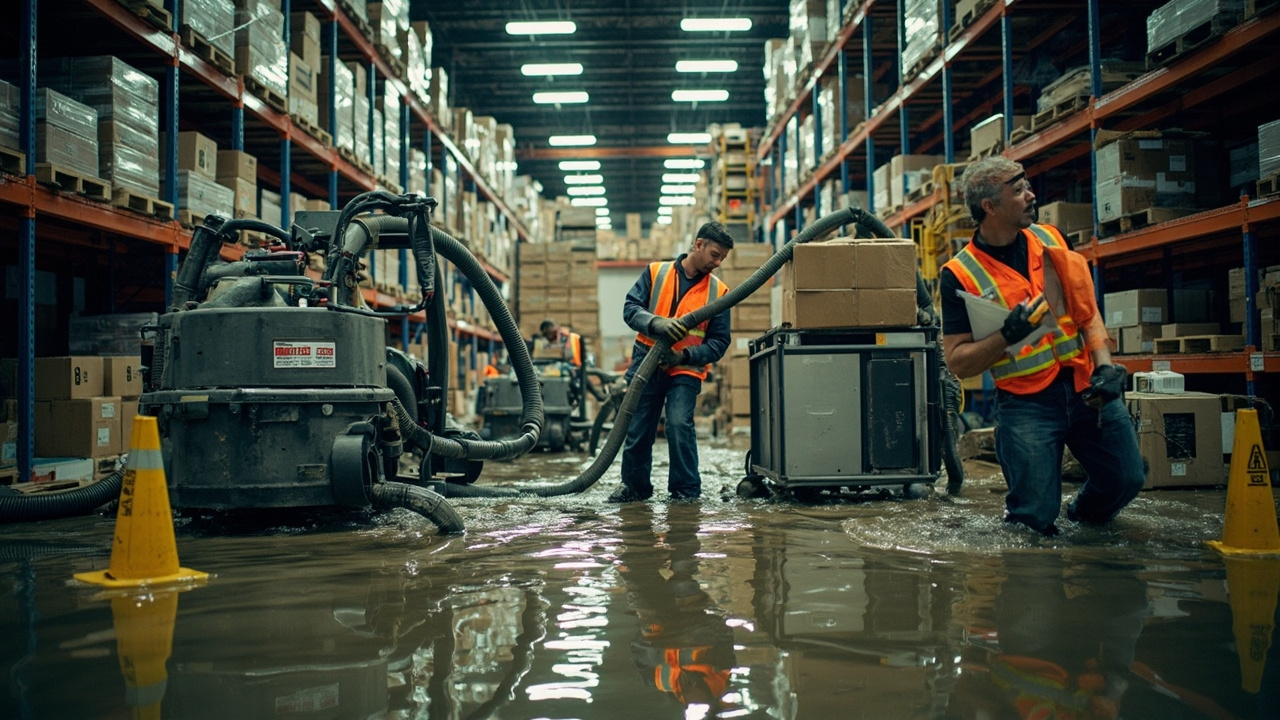
Commercial flood remediation requires a calculated approach that residential contractors cannot execute. We deploy trailer-mounted extraction units capable of removing up to 400 gallons per minute, paired with industrial air movers that create negative air pressure to prevent cross-contamination between affected and clean zones. This matters in facilities storing pharmaceuticals, electronics, or food products where regulatory compliance determines whether you reopen or face shutdown orders.

Our distribution center water removal process starts with zone isolation. We segment your facility using containment barriers, allowing unaffected areas to maintain operations while we address damaged sections. This phased approach keeps your business partially functional instead of completely offline. We document moisture levels using thermal imaging and hygrometers, creating the detailed records your insurance carrier needs for a clean claim and Miami-Dade Building Department requires for occupancy clearance.

Structural drying in warehouse environments differs completely from residential work. Concrete slabs in Miami facilities often sit directly on limestone with no vapor barrier. We use desiccant dehumidifiers that pull moisture from building materials without relying on ambient air temperature, critical in climate-controlled warehouses where we cannot blast heat without damaging inventory. Our hydroxyl generators neutralize odors and airborne contaminants without the downtime required by ozone treatment.

We coordinate with your property manager, insurance adjuster, and operations team simultaneously. You receive real-time moisture readings, equipment logs, and progress photos through a client portal. No waiting for callbacks. No confusion about what happens next. Just transparent industrial water damage cleanup that gets your facility back to code and back to revenue generation.

Our Three-Phase Warehouse Recovery System

Warehouse Flood Restoration in Miami | Industrial-Grade Response That Keeps Your Operations Running
01

Emergency Assessment and Containment

Within 90 minutes of your call, our team arrives with moisture detection equipment and safety gear. We identify electrical hazards, document the affected square footage, and establish containment zones that isolate damaged areas from operational spaces. You receive a preliminary scope with equipment deployment recommendations before we move a single piece of machinery. This assessment determines whether your facility needs partial or full evacuation to meet OSHA requirements during restoration work.
02

Water Extraction and Structural Drying

We position truck-mounted pumps and commercial extractors to remove standing water, then deploy air movers and dehumidifiers in calculated patterns based on your facility's airflow and construction type. Moisture meters track drying progress in walls, floors, and support columns. We adjust equipment placement every 12 hours to maximize efficiency. For refrigerated warehouses, we use low-grain refrigerant dehumidifiers that function in cold environments where standard equipment fails.
03

Sanitation and Clearance Documentation

After structural drying reaches industry standards, we apply EPA-registered antimicrobial treatments to all affected surfaces. Our final inspection includes moisture readings, air quality testing, and photographic documentation that satisfies insurance requirements and local code enforcement. You receive a certified completion report that proves your facility meets health department standards for resuming operations. This documentation protects you from future liability claims and supports your business interruption insurance filing.

Why Miami Warehouse Operators Choose Reliance Water Damage Restoration Orlando

We understand the codes that govern commercial properties in Miami-Dade County. The Florida Building Code requires commercial structures to meet specific moisture thresholds after flood damage, and the county health department enforces strict sanitation standards for facilities handling consumer goods. Generic restoration companies miss these requirements, leaving you vulnerable to failed inspections that extend your downtime and trigger insurance complications.

Our team works regularly with the industrial properties near Miami International Airport, the warehouse corridors along Northwest 79th Street, and the distribution facilities in Medley. We know which buildings have outdated electrical systems that require special precautions during water extraction. We understand how the Biscayne Aquifer affects subsurface moisture in facilities built on filled land near the coast. This local knowledge prevents the trial-and-error approach that costs you days of lost productivity.

We maintain relationships with commercial insurance adjusters, industrial electricians, and refrigeration contractors throughout South Florida. When flood damage affects multiple building systems, we coordinate the specialists you need instead of forcing you to manage five different vendors. This streamlines the restoration process and prevents the scheduling conflicts that turn a three-day job into a two-week ordeal.

Your warehouse generates revenue when it operates, not when it sits empty waiting for equipment to dry. We staff multiple crews and maintain an equipment fleet sized for commercial projects. When you call us for warehouse flood restoration, you get dedicated resources and project management focused on one goal: getting your facility back online before your competitors gain an advantage.

What Your Warehouse Flood Restoration Project Includes

Rapid Commercial Response Times

We dispatch crews to Miami warehouse emergencies within 90 minutes, 24 hours daily. Our response vehicles carry industrial pumps, generators, and safety equipment sized for commercial applications. You will not wait until morning for a callback or deal with a service that treats your facility like a residential claim. We understand that every hour of warehouse downtime equals lost revenue, damaged vendor relationships, and supply chain disruptions. Our team arrives ready to work, with the equipment capacity to handle facilities from 10,000 to 200,000 square feet.

Comprehensive Damage Assessment

Before we start equipment, you receive a written scope that details affected areas, necessary equipment, estimated timelines, and regulatory requirements. We use thermal imaging to detect hidden moisture in walls and columns, moisture meters to establish baseline readings, and facility mapping to plan containment zones. This assessment identifies electrical hazards, contamination levels, and structural concerns that affect your restoration approach. You receive a preliminary report within four hours that your insurance adjuster can review while we begin emergency water removal to prevent further damage.

Certified Structural Drying

We dry your facility to IICRC S500 standards, the industry benchmark that insurance companies and building inspectors recognize. Our technicians monitor moisture levels twice daily and adjust equipment placement to optimize drying efficiency. You receive daily progress reports with updated moisture readings, equipment logs, and photographs that document the restoration timeline. This transparency prevents disputes with insurance carriers and provides the documentation Miami-Dade County requires for occupancy clearance. The final certification proves your facility meets code requirements for resumed operations.

Post-Restoration Support

After completing warehouse water mitigation, we provide a detailed report that includes moisture readings, antimicrobial treatment records, and air quality test results. This documentation supports your insurance claim and satisfies health department requirements for facilities handling food, pharmaceuticals, or consumer products. We offer follow-up inspections to verify that moisture levels remain stable and no secondary damage develops. If you need referrals for electrical contractors, HVAC specialists, or structural engineers to address flood-related damage beyond our scope, we connect you with commercial vendors we trust.

Frequently Asked Questions

You Have Questions,
We Have Answers

What's the difference between remediation and restoration? +

Remediation stops active water damage and prevents mold growth. It includes water extraction, drying, and antimicrobial treatment. Restoration rebuilds what was damaged. This includes replacing drywall, repairing floors, and repainting. Think of remediation as emergency stabilization and restoration as reconstruction. For Miami warehouses, remediation must happen fast due to high humidity accelerating mold growth. Most commercial properties need both services. Remediation gets your facility safe and dry. Restoration returns it to operational condition. The timeline varies based on damage extent, but remediation typically takes 3-5 days while restoration can take weeks depending on structural repairs needed.

How do restoration companies get paid? +

Most restoration companies bill insurance carriers directly through assignment of benefits or work as preferred vendors. For commercial properties, you may pay upfront and file claims later, or the company invoices your insurer after documenting damage. Payment structures include direct insurance billing, third-party administration, or owner payment with reimbursement. Miami warehouses often have commercial policies with different claim procedures than residential coverage. Some companies require a deductible payment before starting work. Get a detailed scope of work and cost estimate before authorization. Larger projects may include progress billing tied to completion milestones. Verify the company handles commercial claims documentation and works with adjusters familiar with business interruption losses.

Who is the alternative to SERVPRO? +

Several restoration companies operate in Miami as alternatives to SERVPRO. Local independent restoration contractors often provide faster response times and personalized service for warehouse flooding. National competitors include Paul Davis Restoration and Rainbow International. Miami also has specialized commercial water damage firms focused exclusively on industrial and warehouse properties. Independent companies understand local building codes, humidity challenges, and hurricane-related flooding patterns specific to South Florida. When selecting a provider, verify they carry commercial general liability insurance, have IICRC-certified technicians, and maintain industrial-grade extraction and drying equipment. Local firms often have established relationships with Miami-Dade commercial adjusters, which expedites claims processing and reduces downtime for your operation.

Is water damage restoration worth it? +

For commercial warehouses, water damage restoration is financially necessary. Unaddressed water damage leads to structural failure, mold contamination, inventory loss, and liability exposure. Miami's humidity accelerates deterioration. Restoration costs are typically covered by commercial property insurance, making it a net-positive investment. Delaying restoration increases total loss through mold spread, concrete spalling, and steel corrosion. Business interruption costs exceed restoration expenses in most cases. Proper restoration protects your building value, maintains code compliance, and prevents health violations. The ROI is measured in avoided losses rather than gained value. Factor in potential tenant disputes, OSHA violations, and property devaluation when calculating worth. Immediate professional restoration minimizes total financial impact.

What are the three types of remediation? +

The three types of remediation are water damage remediation, mold remediation, and fire and smoke remediation. Water damage remediation involves extraction, structural drying, and dehumidification. Mold remediation includes containment, removal, and prevention of fungal growth. Fire and smoke remediation addresses soot, odor, and structural damage from combustion. For Miami warehouses, water damage remediation is most common due to tropical storms, roof leaks, and plumbing failures. Each type requires different equipment and protocols. Water remediation uses extractors and industrial dehumidifiers. Mold remediation requires negative air pressure and HEPA filtration. Many commercial properties need combined remediation when water damage sits unaddressed and mold develops in 24-48 hours.

What are the 3 R's of recovery? +

The three Rs of recovery are rescue, recovery, and restoration. Rescue involves immediate safety measures and damage mitigation. Recovery includes debris removal, water extraction, and inventory salvage. Restoration returns the facility to pre-loss condition through repairs and reconstruction. In Miami warehouse flooding, rescue means stopping water intrusion and securing the building. Recovery involves extracting standing water and documenting losses for insurance. Restoration rebuilds damaged areas to operational status. This framework ensures systematic response. Commercial properties must minimize downtime, so recovery and restoration often overlap. Speed matters in South Florida where humidity complicates drying. The three Rs provide a clear roadmap from emergency response through full operational resumption.

Do you need a license for restoration? +

Florida requires water damage restoration contractors to hold appropriate licenses depending on work scope. General contractors need state licensure for structural repairs exceeding certain thresholds. Mold remediation requires state certification under Florida Statute 468. Water extraction and drying may fall under different regulations. Miami-Dade County enforces additional local requirements for commercial work. Verify your restoration company holds current licenses, carries commercial liability insurance, and employs IICRC-certified technicians. Unlicensed work can void insurance claims and create liability exposure. For warehouse projects, contractors typically need commercial general contractor licenses. Always request proof of licensure and insurance certificates before authorizing work. Licensed professionals understand code compliance and proper documentation for commercial claims.

What not to say to claim adjuster? +

Never admit fault, speculate about damage causes, or provide recorded statements without legal counsel. Do not say the damage is minor or exaggerate losses. Avoid discussing prior claims, settlement expectations, or property value opinions. Do not agree to quick settlements before full assessment. Never say you are unsure about coverage details. For Miami warehouse claims, do not speculate about hurricane versus rain damage classification. Stick to factual damage descriptions. Provide documentation but do not interpret policy language. Do not mention deferred maintenance issues that could void coverage. Let restoration professionals document conditions. Adjusters look for coverage exclusions. Your role is reporting facts, not analyzing causation or coverage applicability. Consult legal counsel for large commercial losses.

Do restoration companies make good money? +

Water damage restoration is a profitable commercial service sector with strong margins on emergency response and equipment rental. Successful companies generate substantial revenue through insurance work, commercial contracts, and emergency services. Miami's hurricane exposure and aging infrastructure create consistent demand. Profit margins vary based on overhead, equipment investment, and claim volume. Commercial warehouse projects typically yield higher revenue than residential work due to scale and equipment requirements. Labor costs, insurance requirements, and equipment maintenance impact profitability. Companies with preferred vendor agreements and strong adjuster relationships maintain steady workflow. The business requires significant capital investment in extraction equipment, dehumidifiers, and vehicles. Seasonal demand spikes during hurricane season affect annual revenue patterns in South Florida markets.

What is the lawsuit against SERVPRO? +

SERVPRO has faced multiple lawsuits involving franchisee disputes, billing practices, and employment issues. Some cases alleged improper insurance billing and inflated estimates. Other litigation involved franchise agreement terms and territorial disputes. Class action suits have addressed wage and hour violations at certain locations. No single lawsuit defines the company. Legal disputes are common in large franchise operations across all industries. When selecting warehouse restoration services in Miami, evaluate individual company reputation, local references, and direct experience rather than national brand litigation history. Focus on verifiable credentials, insurance relationships, and response capabilities. Request detailed estimates, verify licensing, and check local commercial references. Individual operator quality varies significantly in franchise systems.

How Miami's Hurricane Vulnerability Demands Specialized Warehouse Flood Response

Miami sits in the direct path of Atlantic hurricane tracks, and the National Hurricane Center reports that South Florida experiences tropical storm conditions every three years on average. Warehouse facilities in flood-prone zones near the Miami River, Virginia Key, and western Doral face mandatory evacuation orders during major storms. When floodwater breaches your facility, you need industrial flood recovery teams familiar with FEMA flood zone requirements, storm surge patterns, and the contamination issues caused by saltwater intrusion. Miami's porous limestone bedrock allows floodwater to seep through foundation slabs days after surface water recedes, creating hidden moisture problems that generic contractors miss.

Miami-Dade County enforces strict commercial property codes after flood events, requiring certified moisture testing and antimicrobial treatment before issuing occupancy clearances. The county health department inspects facilities that store food, pharmaceuticals, or consumer goods to verify complete sanitation. Choosing a restoration company that understands these local requirements prevents the reinspection cycles that extend your downtime. We work regularly with Miami-Dade Building Department officials and understand the documentation they need. This local expertise helps your facility pass inspection on the first attempt instead of waiting weeks for follow-up reviews.
Water Damage Restoration Services in The Miami Area

Fortress proudly serves the entire Miami area and nearby neighborhoods with prompt, expert water damage restoration services. Whether you're located downtown, in the suburbs, or along the coast, our team is just a call away. Use the map below to view our service area and get directions to our office. We’re local, responsive, and ready to help 24/7—because when disaster strikes, having a trusted team nearby makes all the difference.

Address:
Fortress Water Damage Restoration Miami, 3250 NE 1st Ave, Miami, FL, 33137

Additional Services We Offer

Our news updates

Latest Articles & News from The Blogs

Should You Use Your Insurers Preferred Vendor for Brickell Condo Water Damage? When water floods your Brickell condo, your insurance…

Should You Use Your Insurers Preferred Vendor for Brickell Condo Water Damage?

Should You Use Your Insurers Preferred Vendor for Brickell Condo Water Damage? When water floods your Brickell condo, your insurance…

How to Hire a Restorer Who Understands Aventura Penthouse Plumbing Systems

How to Hire a Restorer Who Understands Aventura Penthouse Plumbing Systems Water damage in an Aventura penthouse is not just…

The Difference Between Surface Cleaning and Deep Extraction for Kendall Area Carpets

The Difference Between Surface Cleaning and Deep Extraction for Kendall Area Carpets When water invades your Kendall home, the first…

Contact Us

Every hour your Miami warehouse sits offline costs revenue and customer confidence. Call (786) 789-8282 now for immediate industrial flood recovery. Our crews deploy within 90 minutes with commercial-grade equipment and the local expertise your facility needs.